
What actually happens with my data?
Your records aren't pasted into a chatbot. They're used to build private training environments where AI practices real work and gets graded against what your company actually did. Here's how that works and why it's worth so much.
It's the first question almost every owner asks us, usually right after "is this real?": where does my data actually go?
It's a fair question. Someone is offering six or seven figures for records you've barely looked at in years, and you should know exactly what they'll be used for before you sign anything.
The short answer: your records are used to build private training environments, where AI models practice real work and get graded against what your company actually did. They aren't pasted into a chatbot, published online or made searchable. Here's the long answer.
Why AI needs your records in the first place
Today's models learned language from the public internet. That's why they can write an email or summarize a contract.
What the public internet doesn't show is how a real business runs. How a quote actually gets built. How an angry customer gets turned around. How a job moves from print to shipped, and what happened when it didn't go to plan. Almost none of that is written down anywhere public, and when it is, the ending is usually missing.
That's the gap. The next generation of AI is being trained to do work, not just talk about it. To learn work, a model needs examples of real work with real outcomes. Your archive is full of them.
What a training environment is
A training environment is a private, simulated workplace built for one purpose: letting an AI model practice.
Think of a flight simulator. A pilot doesn't learn to land in a crosswind by reading about it. They practice in a simulator that recreates the cockpit and the conditions, over and over, and they're scored on every attempt.
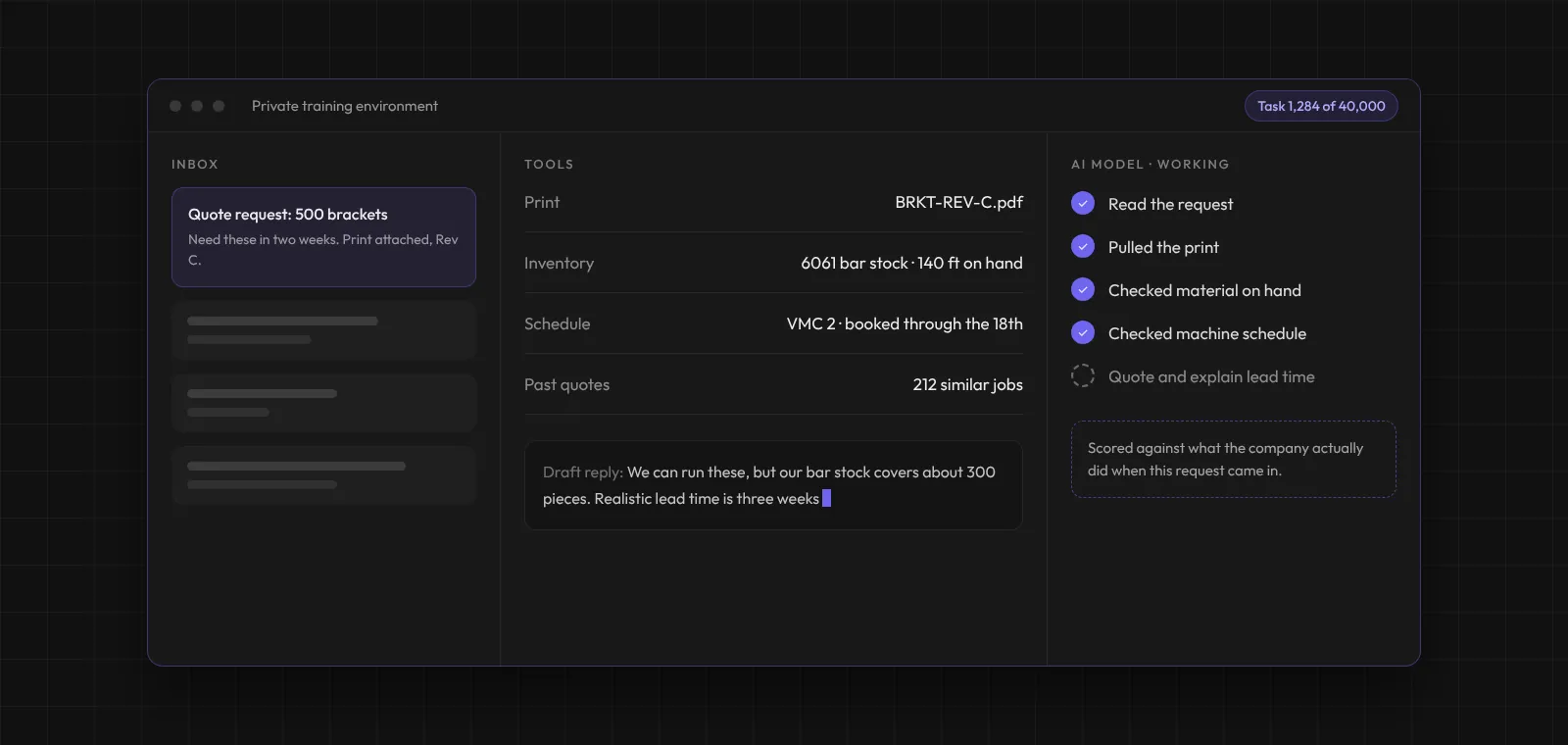
A training environment does the same thing for business work. It recreates the tools a team uses, like an inbox, a ticket queue, a project folder, a parts list or a machine schedule, and loads it with real situations drawn from de-identified company records. The model gets a task, works through it with those tools and is scored on how it did.
This kind of training is called reinforcement learning. The model isn't reading your files to memorize them. It's practicing decisions and getting feedback on each one.
How your records become tasks
Every record in your archive is a situation with a known ending. That's what makes it useful.
Take a simple example. A customer emails asking for a quote on 500 brackets with a two-week lead time. Your team pulls the print, checks material on hand and sees the bar stock only covers about 300 pieces. They quote three weeks instead of two, explain why and offer to ship the first 300 early. The customer accepts.
In a training environment, that becomes a task. The model gets the same email, the same print and the same inventory and schedule data your team had. What it doesn't get is your team's answer. It has to work the problem out on its own.
How the model gets graded
When the model finishes, its answer is compared to what your company actually did. Did it pull the right print? Did it catch the material shortage? Did it quote a realistic lead time? Did it handle the customer the way your team did?
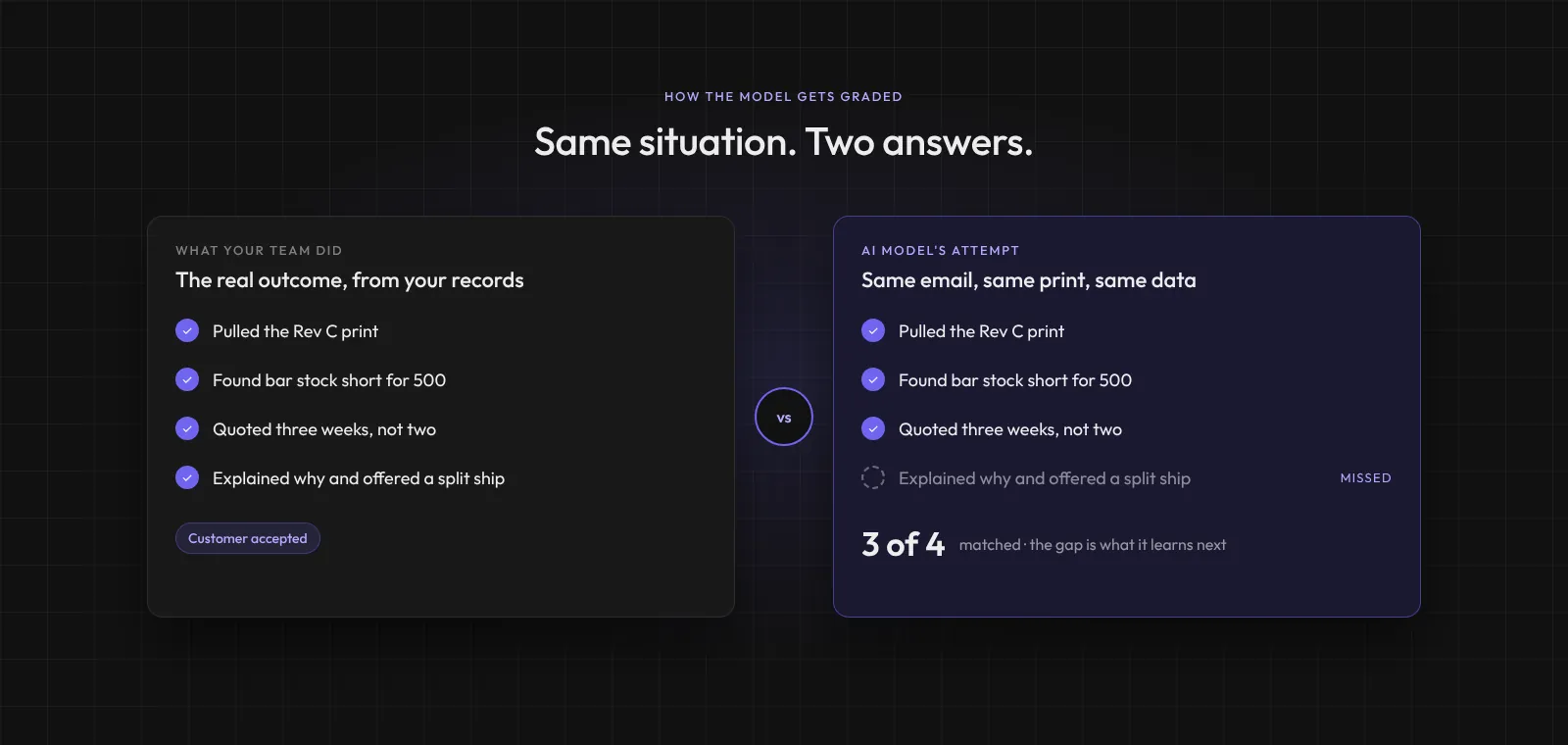
Where the model matched your team, that approach is reinforced. Where it missed, the gap shows exactly what it still needs to learn. Then it moves on to the next situation, and the next, across thousands of tasks.
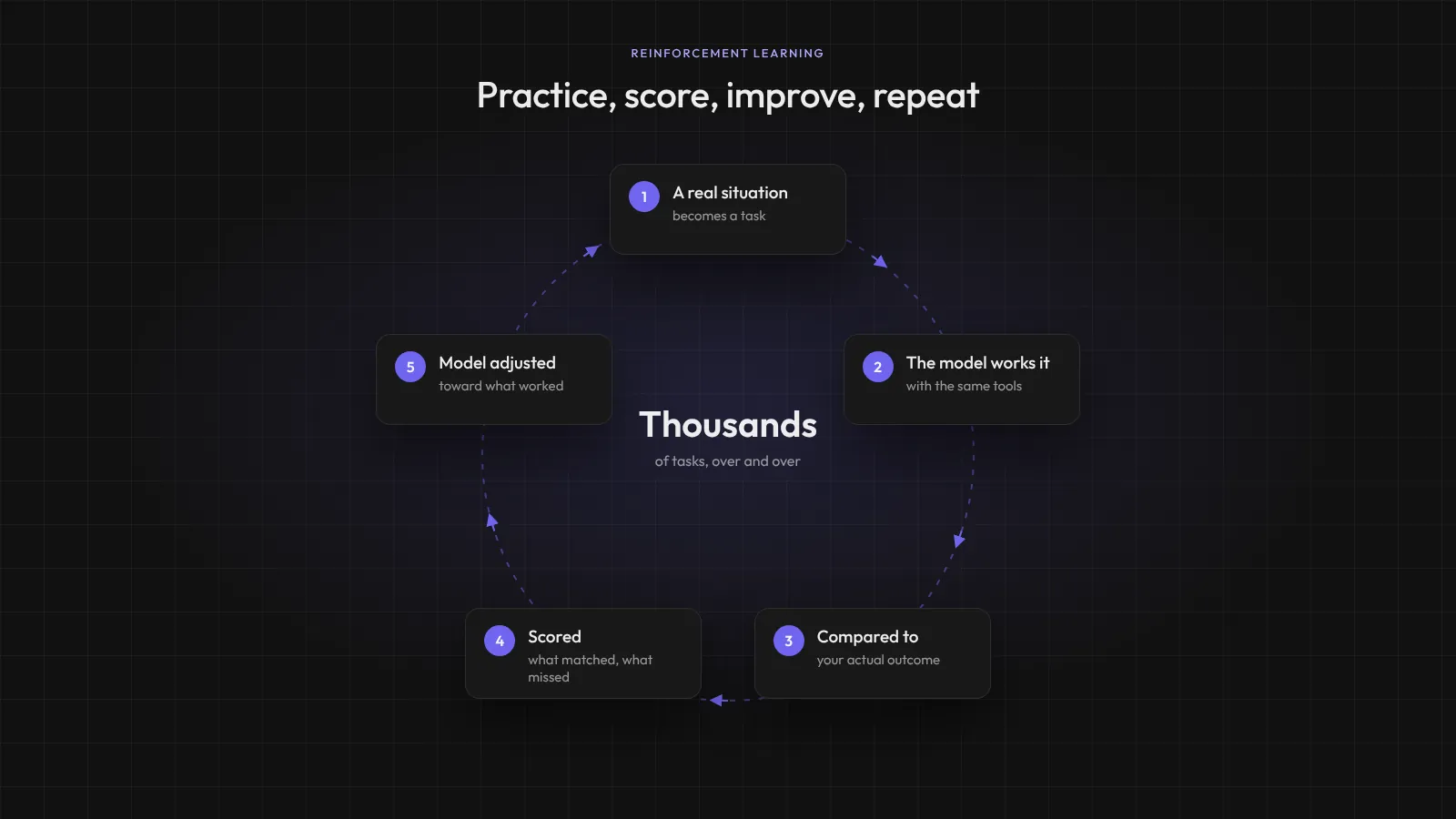
- A real situation from your records becomes a task.
- The model works through it with the same tools and information your team had.
- Its result is compared with what your company actually did.
- It's scored on what matched and what it missed.
- The model is adjusted toward what worked, and it moves on to the next task.
Over enough rounds, the model gets better at the work itself: reading a situation, finding the right information and making the right call.
Why your records are worth so much
This is where the price comes from.
Public data shows what people say. Your records show what a business of your size and type actually did, step by step, with the result attached. That last part is the valuable piece. A task is only useful for training if there's a right answer to grade against, and your company has already produced that answer thousands of times.
It's also why some things matter more than others:
- Depth of history. Ten years of records means ten years of situations with known endings. Ten years of ordinary records usually beats two years of interesting ones.
- Complete threads. The request, the files, the back-and-forth and the result for the same job or ticket. A thread with its ending missing can't be graded.
- How your business actually runs. A 40-person machine shop, a staffing agency and an insurance agency all make different calls in different ways. Each one teaches a model something the others can't.
It's also why made-up data doesn't work as a substitute. A model trained on invented situations learns invented answers. Real outcomes are the whole point.
Where your data doesn't go
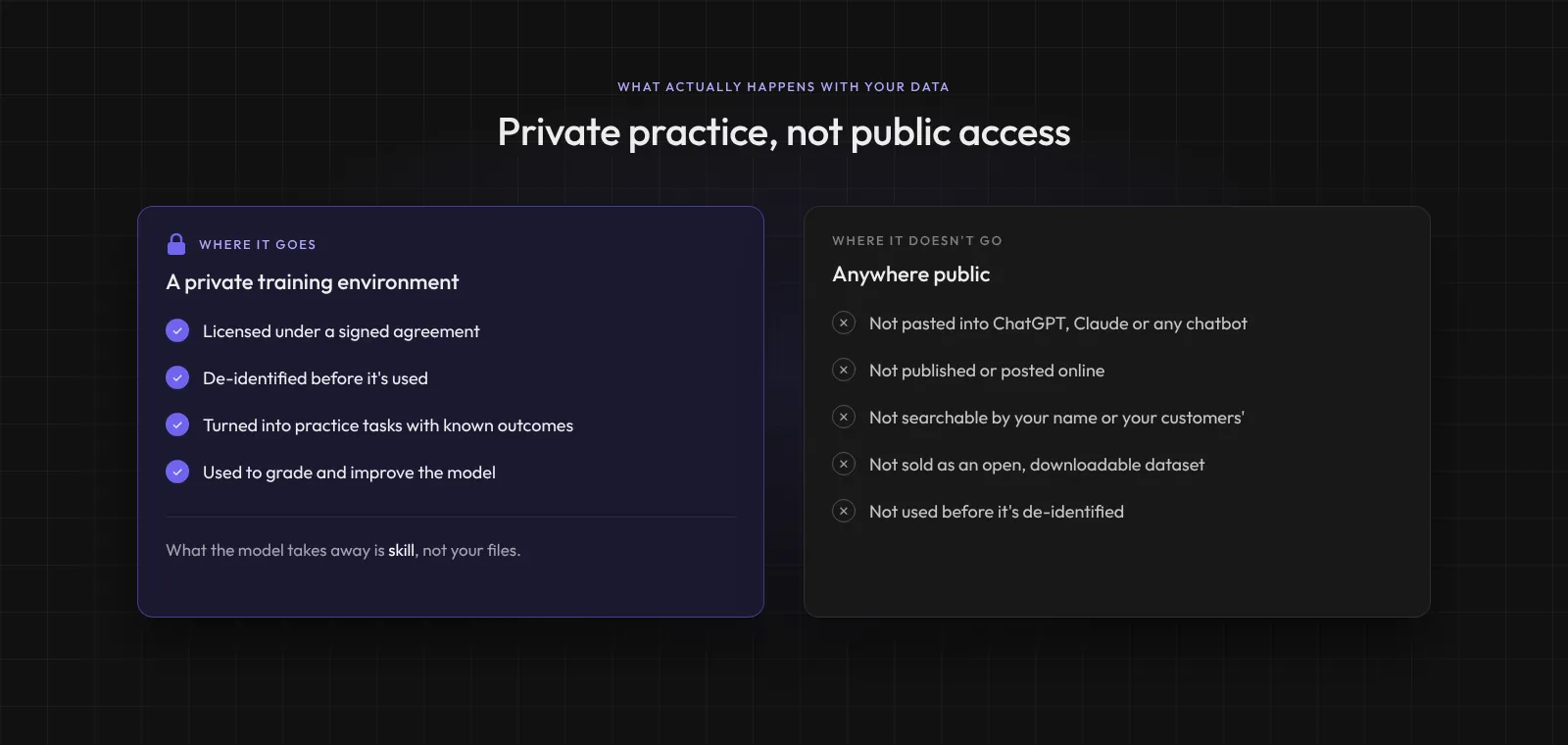
- It isn't pasted into ChatGPT, Claude or any other chatbot.
- It isn't published, posted or put anywhere public.
- It isn't searchable. Nobody can look up your company, your customers or your records.
- It isn't sold as an open dataset anyone can download.
- It isn't used for anything until it's been de-identified.
What the model takes away is skill, not your files. Your records teach it how good decisions get made. They aren't there for it to repeat back.
How it's protected along the way
- The agreement comes first. You sign before anything is transferred, and you approve exactly which records are in scope.
- Encrypted transfer. Files move over an encrypted transfer onto our internal systems.
- De-identification. On our internal systems, customer names, part numbers and anything under NDA are removed or masked. Health information is de-identified. ITAR and EAR-controlled data is excluded.
- Only then is it used for training. De-identified records are what get built into training environments.
And you keep everything. It's a license, not a sale. Every file and every system stays yours, and you keep using them exactly as you do today.
Common questions
Will an AI be able to answer questions about my company?
That's not what your records are for. They're de-identified and used to teach a model how to work through tasks, not to give it a file of facts about your business to recite.
Could a competitor get my data?
Your records are licensed under a signed agreement. They aren't published or sold on an open market, and the exclusivity terms are written into your agreement.
Do you need all of our data?
No. You approve the exact scope before anything is transferred, and anything you exclude never leaves.
Why not just use synthetic data?
Synthetic data doesn't have real outcomes. You can't grade a model against an answer nobody actually reached.
What does my team have to do?
Very little. Whoever runs your systems handles the export, our team stays on to answer questions and day-to-day work isn't interrupted.