
How our deals actually work
From the first call to the wire hitting your account, here's every step of a Cognor Labs deal, what we ask of you at each one and what we never ask for.
Most owners hear about data licensing the same way. An ad shows up in their feed, someone calls the front desk or a friend mentions they got paid for their company's old email. The first reaction is almost always the same: that sounds too good to be real.
That's a healthy reaction. You should ask hard questions before you share anything about your company, with us or anyone else. So instead of a sales page, here's the whole process laid out step by step: what happens, what we ask of you, how long each part takes and where the money comes from.
The short version
A Cognor deal has six steps. Most of the work on your side is in the middle, and none of it involves handing over your full data before you've signed.
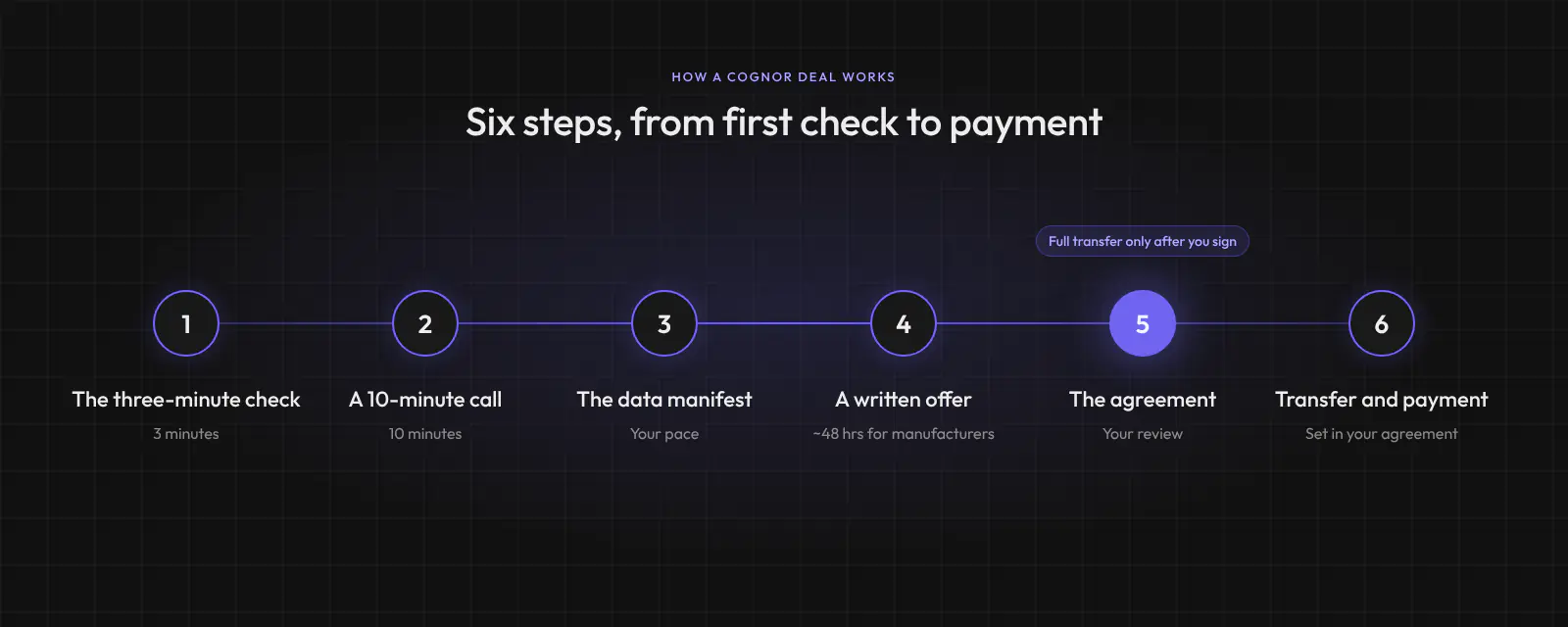
- The three-minute check: tell us about your company (3 minutes)
- A 10-minute call: systems, history and rough volume (10 minutes)
- The data manifest: an inventory of your records, not the records (your pace)
- A written offer: scope, amount and payment terms in writing (about 48 hours for manufacturers)
- The agreement: nothing transfers before you sign (your review)
- Transfer, acceptance and payment: encrypted transfer, then wire or ACH (set in your agreement)
Why anyone pays for old business records
AI is moving past chatbots. The labs building today's models are training them to do real work: answer a support ticket the way your best rep would, follow a project from kickoff to delivery, quote a part, check a design before it goes to fab.
To learn that, models need examples of how work actually gets done inside real companies. The public internet doesn't have much of that. Your archive does. Years of email threads, internal chat, tickets, project files and production records show the back-and-forth of real decisions, which is exactly what these models are missing.
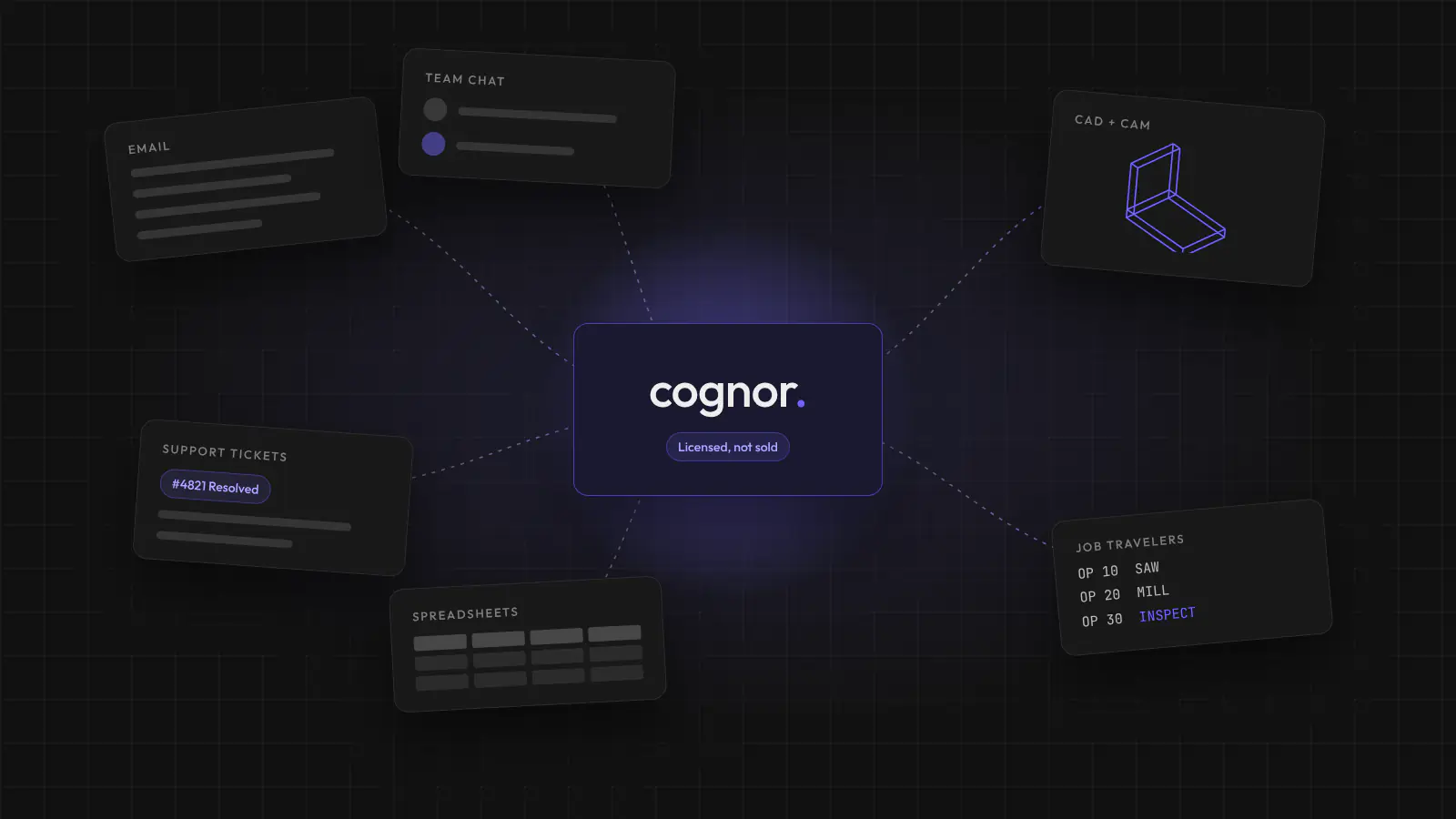
That's why it's a license and not a sale. You aren't giving anything up. You keep every file and keep using every system exactly the way you do today. What you're granting is the right to use a copy of those records for training, under terms you've read and signed.
Step 1: The three-minute check
It starts with a short check on our site. It asks about your industry, your headcount, how long you've been operating and the systems you run on.
The goal is simple: figure out quickly whether your records are likely to be a fit, so nobody wastes a call. Most companies we work with have at least 20 employees and three or more years of records. For manufacturers, depth of operating history matters more than size.
Step 2: A 10-minute call
If the check looks like a fit, you'll get on a short call with our review team. There's no pitch deck. We'll ask what systems you use, how far back your records go and roughly how much data there is. You can ask us anything.
By the end of the call you'll know whether a deal is worth pursuing and which path it's likely to take.
Step 3: The data manifest
The manifest is an inventory of your records, not the records themselves. For each source you list the system, how many years it covers and roughly how large it is.
The sources we see most often:
- Email and shared mailboxes
- Team chat like Slack or Teams
- CRM and support ticketing
- Project and task management
- File storage like Google Drive, SharePoint or Dropbox
- Accounting and payroll systems
- Technical files: CAD, CAM programs, ERP history, design packets and test data
The more complete the manifest, the stronger the offer. A source you forget to list is a source that can't be priced, so it's worth checking with whoever runs your IT before you submit.
Manufacturers and electronics companies also share a small set of sample files through a secure link. You choose what's included. Samples are handled the same way as the full set: de-identified on our internal systems before anyone outside our team sees them.
Step 4: A written offer
For manufacturers and electronics companies, we send a written offer, typically within about 48 hours of a complete manifest. For other industries, the licensing program we've placed you with issues the offer, and we walk you through it.
Every offer is in writing and spells out which records are covered, the amount and the payment terms. Placements range from $100K to $2M.
What moves the number
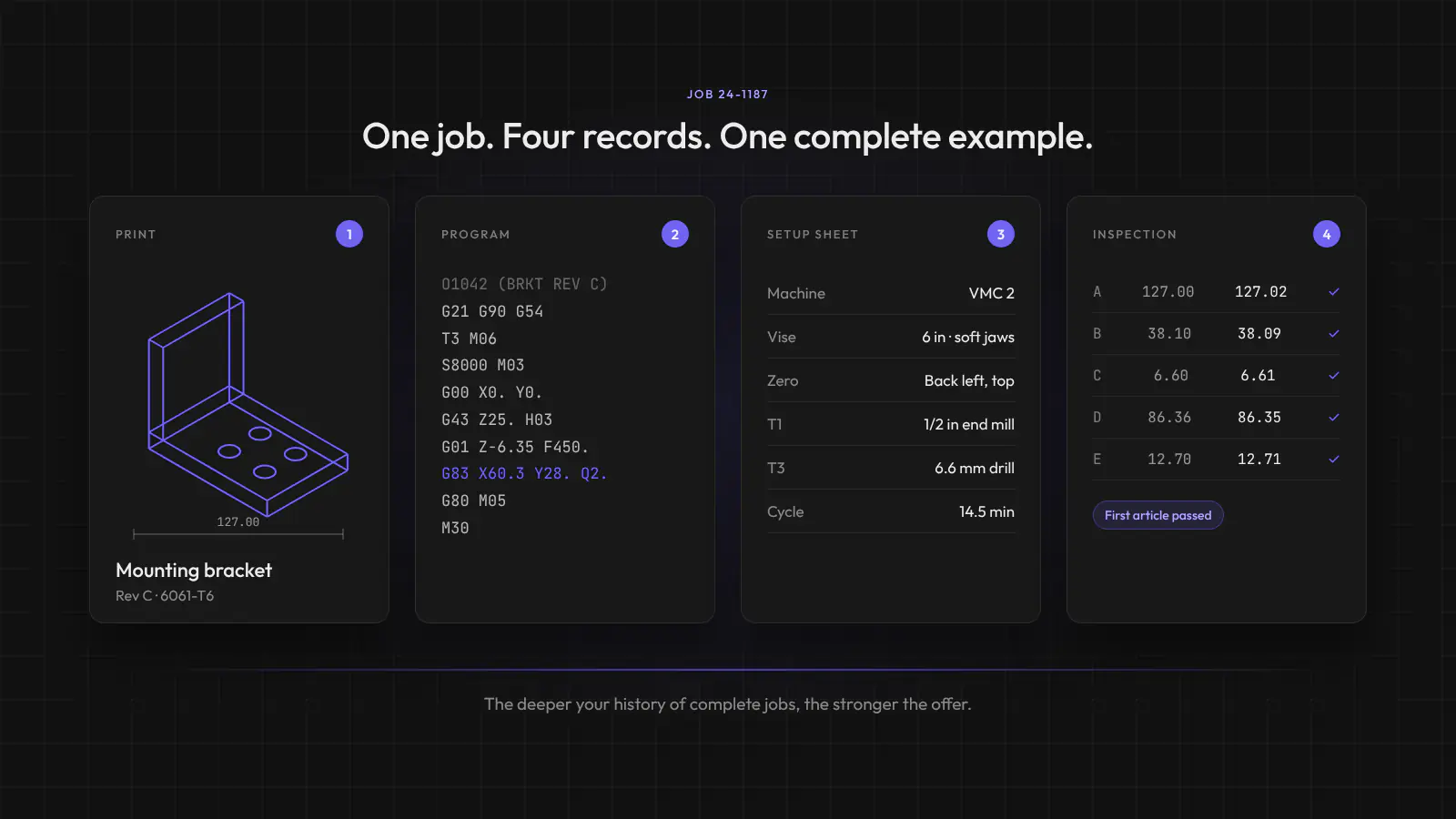
Depth of history matters most. Ten years of ordinary records usually beats two years of interesting ones. Volume and completeness come next. For a machine shop, that means the travelers, setups, programs and inspection records all exist for the same jobs. For a PCB design house, it means complete design packets for the same board. Headcount on its own matters less than most people expect.
Recent closes
- $747KHeavy machining and fabrication shop
- $445KPCB design house, Michigan
- ~$750KHealthcare staffing agency
- $565KHealth tech company
Amounts are what the company was paid, rounded. We don't publish company names.
You can turn any offer down. There's no cost to get one and nothing owed if you walk away.
Step 5: The agreement
Nothing transfers until you sign. Who you sign with depends on your industry.
Manufacturers and electronics companies
Cognor Labs is the licensee. You sign with us and only deal with us. We pay you directly.
Every other industry
We place you with a vetted licensing program that fits your records. You sign with that program and they pay you directly. We stay on as your point of contact the whole way through.
The agreement covers the licensed records, the exclusivity terms, the payment amount and the payment schedule. You'll know exactly how and when you get paid before you sign anything.
Read it closely. If a clause concerns you, tell us which one and we'll walk you through what it means and why it's there. Most questions are answered by language that's already in the agreement.
Step 6: Transfer, acceptance and payment
The transfer
Once the agreement is signed, our data team gets on a call with whoever handles your IT. Exports come from the systems you already run, and our team stays on to answer questions until the transfer is done. For very large archives we sometimes handle the extraction on-site.
You decide what's in scope before anything is transferred. Anything you exclude never leaves.
De-identification
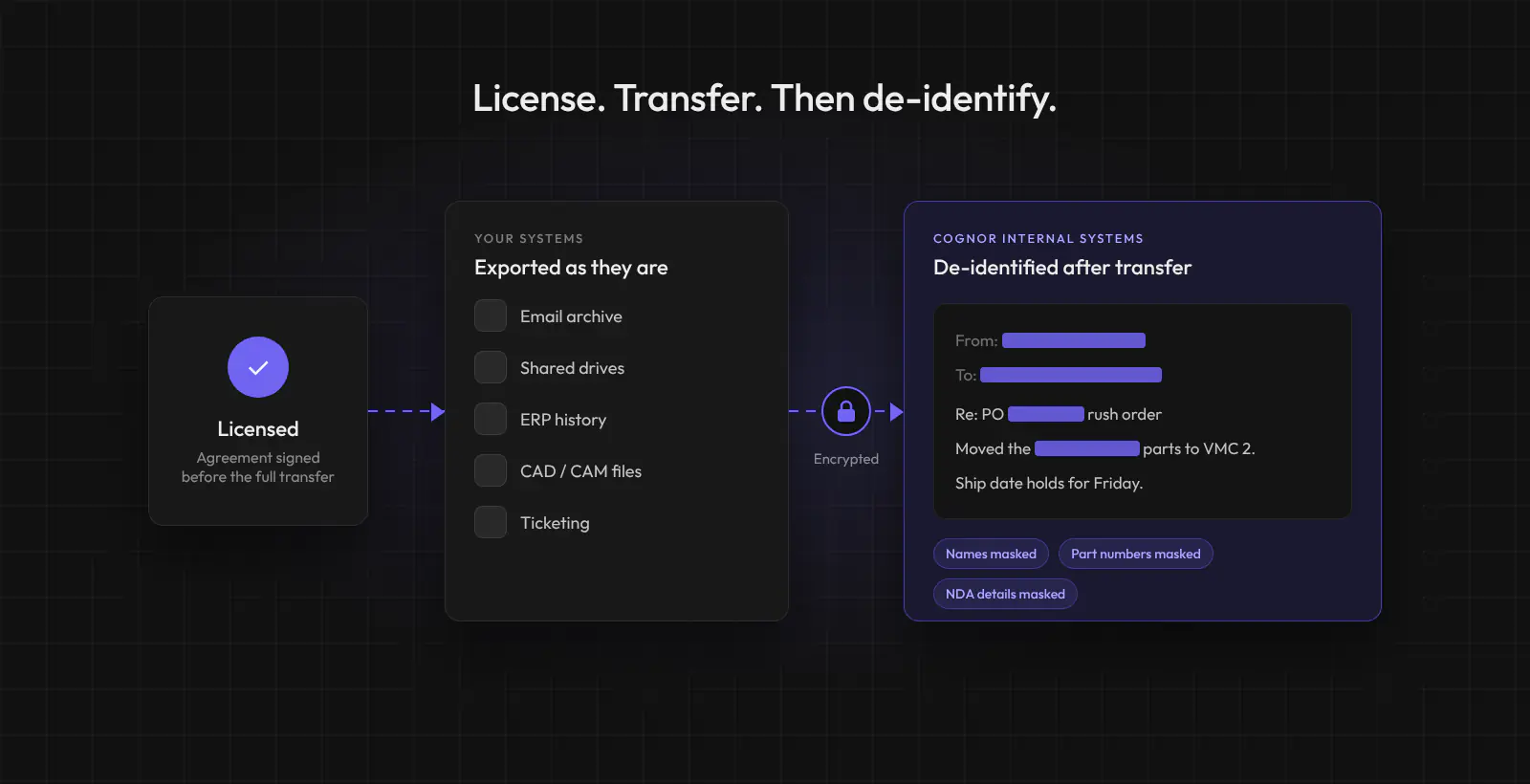
Files move over an encrypted transfer into our internal systems. That's where de-identification happens, after the transfer and before the data is shared with anyone outside our team. Customer names, part numbers and anything under NDA are removed or masked. Health information is de-identified. ITAR and EAR-controlled data is excluded. You don't have to anonymize anything yourself.
Acceptance and payment
The transferred data is checked against what was described in the manifest. Once it's accepted, payment goes out by wire or ACH on the schedule written into your agreement. Manufacturers and electronics companies are paid directly by Cognor. Companies in other industries are paid directly by the licensing program they signed with.
You never pay Cognor anything.
What we never ask for
- Fees of any kind
- Passwords or login credentials
- Bank account or card numbers on a call
- Your data before an agreement is signed, other than the sample files you choose
If anyone claiming to be Cognor asks you to pay for anything, it isn't us. Email support@cognorlabs.com.
How long it takes, honestly
The check, the call and the manifest can all happen in the same week if you move quickly. Manufacturers typically have a written offer about 48 hours after a complete manifest. Signing takes as long as your review takes.
The longest stretch is usually the transfer and acceptance, and it depends on the size of your archive. A few mailboxes and a file server move fast. Decades of production data or an on-site extraction take longer. Your agreement sets the payment schedule, so you'll know the timeline before you commit.
Common questions
Will my team notice anything?
Very little. Exports are run by whoever manages your systems, and day-to-day work isn't interrupted. Your team keeps using everything as usual.
Does this include our customers' personal information?
What's valuable is the operational side: how your team communicates, plans and gets work done. Identifying details are removed or masked on our internal systems after transfer, and health information is de-identified.
Do we have to anonymize anything ourselves?
No. You export the files as they are and send them over an encrypted transfer. De-identification happens on our internal systems after transfer.
We're in the middle of selling the company. Can we still do this?
Often, yes. We've worked with a number of companies mid-sale, and a license can put extra cash in the seller's pocket on top of the sale price. Tell us your timeline on the first call.
What happens if the deal doesn't close?
Nothing. You owe nothing, at any stage.
Can we keep using our data?
Yes. It's a license, not a sale. Every file and every system stays yours.